|
| The true work of art |
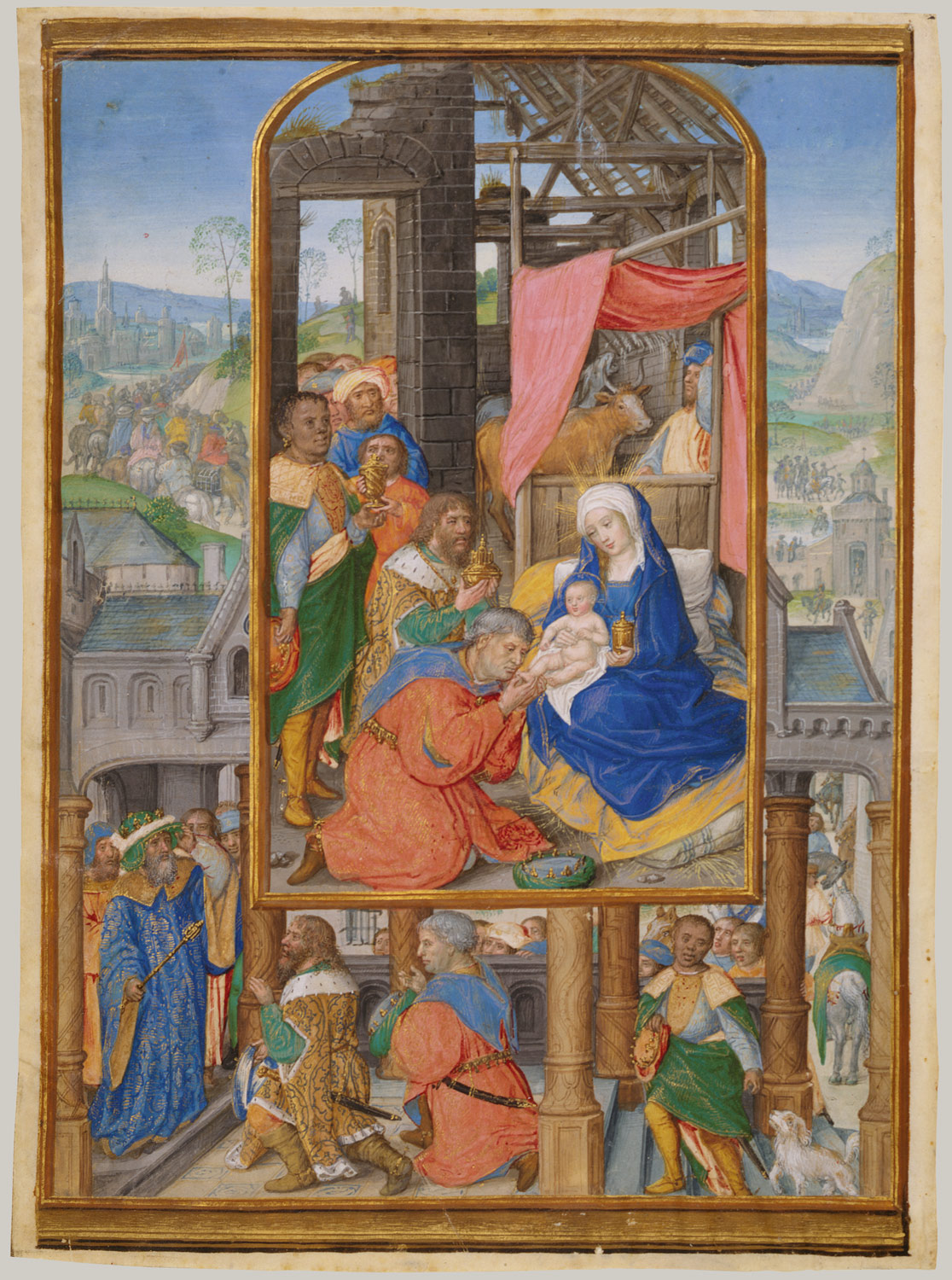 |
| Manuscript Illumination with Adoration of the Magi |
Background Information:
Title: Manuscript Illumination with Adoration of the Magi
Artist: Master of James IV of Scotland (probably Gerard Horenbout)
Date: ca. 1515–25
Medium: Tempera, ink, and shell gold on parchment
Size: 6 1/2 x 4 5/8in. (16.5 x 11.7cm)
Stylistic Period: Renaissance
Culture: South Netherlandish
Analysis:
"Manuscript Illumination with Adoration of the Magi" is a painting from the Book of Hours, a collection of devotional prayers. According to The Met Museum, the book's purpose was to inspire devotion for the non-ordained. Book of Hours' earliest surviving English copy was written for a laywoman living in Oxford in about 1240 (University of Glasgow). The book had vast popularity in Northern Europe since it's original creation in 1240 up to the end of the 1600's.
The subject is Virgin Mary holding Jesus, surrounded by three kings with gifts. Outside of this, the townspeople appear to be praising the middle of the image, which is Virgin Mary holding Jesus. This represents the famous scene from the bible of Jesus' birth. In this, Jesus is held by his mother, Mary, and surrounded by wise men. The use of background and foreground are very significant in the piece. The focal point of the story, Jesus' birth, is placed in the middle and front of the image, while the townspeople are in the background. The townspeople however all carry facial expressions of joy and praise. This could represent how Jesus carries sole importance, and society is second to that. Although the townspeople are not as important in the world, they gain their joy from Jesus. Secondly, the artist stresses the use of colors to emphasize the importance of certain subjects in the image, such as Mary and Jesus. In the scene, Jesus is naked, which didn't shock me at first since he was first born. However, when sketching the image myself, I realized that Jesus being naked led to his light skin tone being shown. He is the only person in the scene in a light, bare color. Even those who are clothed are in colors with darker undertones. This portrays how he is the most important subject of the scene, and the artist wants the viewer's eyes to be drawn to Jesus right away. Virgin Mary has gold, spark-like pieces above her head, showing a glow around her. This is also the only time there is something truly glowing in the image, since all the other colors used were dull, such as the wise man's forest green and the building's stony grey. This adds emphasis to Mary, and in combination to the light colors of Jesus, shows that Mary and Jesus are the true subjects of the image and the focal point for a viewer. The artist's use of foreground, background, color, and emphasis, all aid in the portrayal of the meaning of the work; to communicate the value of the Christian life. The foreground and background placements shows how the townspeople find pleasure in the birth of Jesus, portraying that a life with Christ comes with pleasure and happiness. The use of bright colors on Mary and Jesus communicates that they are the light of the world, immediately giving them value. The emphasis on the birth scene also shows how Jesus' birth is a symbol of Christianity, and therefore encourages people to follow Jesus, since he is a key feature of the religion.
This work conveys the popular religious themes of the 1500's era because it shows a town revolving around a religious ideal. This time period in England hosted the Great Reformation, an event centering around the creating of other branches of Christianity than Catholicism, due to new found corruption in the Catholic Church. Because of this, the people of England were surrounded by religious beliefs since the reformation encapsulated the Church and politics of the time. Another possible motivation for the creation of this piece is that the artist wanted people to remember the basis of Christianity, and forget the political issues going on. This theory would be supported both by the chaotic context and the stylistic emphasis on Jesus' birth. The value of the artwork remains the same today, since it serves as a portrayal of the basis of Christianity: Jesus' birth. Since the religion itself still holds the same values, the artwork still communicates the same message of showing the values of a life with Christ. However, today the image would most likely not be appreciated the same as it was in it's original time period. This is due to the fact that there are now numerous paintings similar to this, that all portray Baby Jesus' birth. There is also less of a reliance on artwork as a method of communication in society now, as technology has taken it's place. In the 1500's however, the artwork was used as a way to communicate feelings and emotions. Now, we simply take to twitter for an angry rant.