Sunday, December 15, 2019

Lady Macbeth's Netflix List


Netflix is an amazing way to pass time on a lazy Saturday.  For Lady Macbeth, she uses Netflix so she feels a little less evil and a little better about herself.  Sometimes, she even finds manipulative inspiration from her shows. 

#1- How to Get Away With Murder
Image result for how to get away with murder show
The title already fits classic Lady Macbeth, wondering all throughout Macbeth how she, herself, can get away with murder.  How to Get Away With Murder is a drama about a criminal defense attorney and law professor who works to cover up a murder committed by one of her interns and students. The defense attorney is confident and respected, however has many secrets kept inside her. Her hiding of her secrets portrays a situation of appearance versus reality, where she appears well-rounded, however inside she is having evil thoughts and secrets. Similarly, Lady Macbeth's appearance is respectable and confident, while she is actually concealing a murder.

#2- Gossip Girl
Image result for gossip girl
Gossip Girl is a show that revolves around lives of "the rich kids of New York." The main character, Blair, is a manipulative, snobby girl who is constantly causing drama and is the root of numerous arguments in the show.  Similarly, Lady Macbeth shares the same character traits, and is the driving factor of the plot, since she is the one who motivates the first killing in Macbeth.  The ambition both Blair and Lady Macbeth hold defines their characters.  However, they also lead to the downfall of each because throughout the show, Blair has many internal conflicts that are sourced from the drama she creates. Lady Macbeth's ambition of power and murder ends up leading the plot to her own death.  Therefore, while Lady Macbeth is watching Gossip Girl, she is enjoying the drama Blair creates and harm Blair emotionally does to others.  This enjoyment then makes Lady Macbeth feel like she isn't so bad.

#3-The Blacklist
Image result for the blacklist
The Blacklist's plot is based off the story of a former government agent Raymond "Red" Reddington, who was on the FBI's most wanted list.  He suddenly turns himself in to the FBI with an offer to help catch a terrorist under the condition that he speaks only to Liz, a young FBI profiler.  Red is a mysterious character because of how deceitful he is.  Each of his decisions have been heavily thought out and his words can be manipulative to favor what he wants.  Lady Macbeth would love this show because she would find extreme interest in Red's behavior and would be looking for some tips she could use herself on how to manipulate a system.

#4-House of Cards
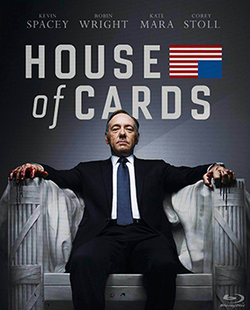
Image result for house of cards
House of Cards is a show about a ruthless politician named Walker and his wife, Claire, as they rise in power within the United States Government. Ambition holds the duo together as they obliterate others to gain more of their own power.  Walker and Claire use ambition, greed, and corruption to make their way to the top politically, and end up tearing apart others' careers in the process.  Lady Macbeth is captivated with the situation because desires to live the life of a power couple like Walker and Claire. She loves how they work together in evil and support each other in corruption. Although she is unaware, she is also drawn to the show because it is similar to her life, where her and Macbeth destroy others in order to obtain the highest power possible. 

#5-Insatiable

Image result for insatiable netflix
Insatiable is the story of Patty, a girl who struggles to fit in and be accepted by society.  She lived most of her childhood overweight, causing her to be overlooked.  However, now she has lost all her excess weight and is ready for revenge against those who doubted her.  Lady Macbeth would love Patty's character because it inspires her.  Once Patty gets the revenge she desires, other aspects of her life begin to come together.  For Lady Macbeth, this shows her that once she kills those who underestimated her power, it will be all uphill from there.  Both Patty and Lady Macbeth are driven by ambition, Patty's ambition of revenge and Lady Macbeth's of power.  

Sunday, December 1, 2019

Macbeth

Prompt: Why do people who are not "evil" take the first step into evil? What, for instance, is involved in taking that first step "down the primrose path to the everlasting bonfire" (Macbeth, 2.3)? What are the consequences of the individual choosing evil (particularly the internal consequences)? Use examples from the text to support your opinion.

I believe that all people are born without evil intents, however society soon presses evil desires on each individual.  These desires surface in a variety of different ways, some are minor such as jealousy and some are slightly more significant, like murder.  In the context of the prompt, evil will be defined less as the everyday "sins" and more as significant events, such as murder, robbery, etc.  Based on my reading of Macbeth and personal rationals, I believe people become evil as a result of a buildup of "minor evils."  Therefore, a life full of greed, dishonesty, and deceit can lead someone to become evil, in the belief that if they can get away with the smaller sins, they can also get away with the larger.  

In Macbeth, the character of Macbeth undergoes this "evil transformation."  In the beginning, Macbeth is a loved war hero. However, throughout the plot, he advances into a very different man.  By act four, we see Macbeth as a murderer, the "ultimate evil." Macbeth is told a prophecy of him becoming kingm and the first step of it becomes true when he is crowned Thane of Cawdor.  This begins a root of a superior feeling, and Macbeth expects he can become king just as easy, since he is now superior.  However, Macbeth's true intentions are revealed when he says “stars, hide your fires; Let not light see my black and deep desires” (Macbeth Act 1 Scene 4). When Macbeth hears King Duncan say Malcolm will be next in line for the throne, it sends him into a downward spiral of anger and greed.  This quote reveals Macbeth’s character as he begins his evil fate.  The metaphor of his deep and dark desires further portrays how Macbeth is aware of his evil intentions, however he has no feeling to ignore them, rather just hide them to protect his image. This quote is very significant for the play because it foreshadows how Macbeth's "deep and dark desires" will be revealed later on.  His character ends up murdering multiple people, therefore the quote shows it is only the beginning of his evil fate. 

In act two, scene three, we see Shakespeare refer to evil as "down the primrose path to the everlasting bonfire." The imagery created is very ironic because at first read, it sounds like a garden scene.  However, everlasting bonfire refers to hell.  Also, a primrose path occurs when someone is led down a path they believe is good, even when they may be aware of bad consequences of this path (Oxford).  In other words, the shorter pleasure is better than the long term effects.  With the definition specifically involving a person leading another down the path, I then realized the importance of Lady Macbeth in Macbeth's evil fate.  Throughout the play, she encourages his evil ambition by using a guilt trap.  "I have given suck, and know how tender ’tis to love the babe that milks me. I would, while it was smiling in my face, have plucked my nipple from his boneless gums and dashed the brains out, had I so sworn as you have done to this" (Macbeth Act One Scene 7).  This portrays how Lady Macbeth is trying to convince him that she is capable of evil acts and that he should be too.  This then is an example of Lady Macbeth leading Macbeth down the primrose path, by a peer pressure guilt trap.  Because Macbeth doesn't want to appear less of a man and wants to retain respect, like all men would, he feels the pressure to match Lady Macbeth's ambition.  

As the play moves on, the audience quickly is shown the results of this choice.  Macbeth is overcome with emotion, and creates an internal conflict of his evil desires versus his good conscience.  After his first murder, he begins to have images of beasts fill his mind. Some of these include “rugged russian bear,” “arm’d rhinoceros,” and “hyrcan tiger.” The fact that he is now speaking about vicious beasts, and bringing them up in constant conversation shows that his mental and emotional strength are now in question.  The weight of his actions are bearing him down because while he satisfied his evil desires, he craves more yet still has a good conscience asking him if this is right.  This juxtaposition of his evil desires and more practical beliefs leads Macbeth to be crazy, speaking of beasts.  

In conclusion, man is driven to evil through two ways.  First, he experiences a buildup of "small evils", such as greed and dishonesty.  Secondly, someone is led by a peer, or encouraged.  Although it seems like a wild plot in Macbeth, of him being greedy for the throne and Lady Macbeth encouraging murder, we see this every day in our own lives on a different scale.  A man today may have greed by an excessive value being placed on money, and that building of greed can lead them to steal.  In extreme cases of stealing, robbers are almost always accompanied by an accomplice, someone encouraging them.  As a high school student, I can see this through peer pressure.  We are constantly tempted by various subjects, and at some point we had a friend encourage us to do something we knew we shouldn't, but deep down had a craving to, just like Macbeth.  The personal implications of this are that most will have some type of regret, or find themselves too deep in a situation to remove themselves.  This leads to the breaking of a mental and emotional state.